Sunday, September 23, 2007

the icon and its maker


In the 1970's, a piece of land art was constructed that spiraled off the Great Salt Lake.

The image and the memory, even if second hand, is pretty indelibly marked on several different groups and generations.

Understand, artist Robert Smithson has made no noises about claiming, in fact he is rather quiet.

So the questions here are rhetorical and meant to stretch to other iconographic works as well.

Is the artist responsible now for the archetypal quality, the coil of dense projection that has happened to this work?

Did he simply create the work and the interaction with the environment- and now should not accept the mastery or ownership-

I DID IT I DID IT I DID IT


Let go let go Let go

rascals


simonbellphotography.com

There are rascals in the world, and some of them are blue. Blue, with articulated eyebrows and feather capes.

When they first arrived, I had a misguided thought that I could train them to come to a command or clap.

I would match a clap with food.

But I was very very eager, and would find myself jumping up from my work when I heard them in the trees, stick my head out the window, and clap.

It wasn't long before I realized that they had trained me.

Trained me to pop out of the window at the sounds they made, sitting in the woods.

They can't clap, they have wings.

It doesn't matter, the rascals had won.

Tuesday, July 3, 2007

curiosity

The night sky .
(Click to enlarge.)

Ole Wurm's Kunsthammer

Turns out that wedged into the list of motivations and drives for a human being's old brain survival mechanisms-

(sex, hunger, thirst..)

is Curiousity.

Just the sheer tug of wanting to know what's outside the cave entrance- what is that little shiny thing winking and blinking, what is that strangely shaped object, what is that insect?

Curiosity helps our little human race progress- but certainly at a cost.

The idea of a room, or a case, or a box or even an entire museum dedicated to storing, squirreling, and collecting oddities is very appealing to me.

They could be actual objects, or perhaps concepts or dreams or half finished thoughts?

If you each out side the cave, you could retrieve something incredibly vital.

Or you could get eaten.

That's pretty much the deal.

www.strangescience.net/biopics/oleworm.jpg

http://home.no.net/ekerilar/computus_runicus.htm

http://en.wikipedia.org/wiki/Cabinet_of_curiosities

"In 1587 Gabriel Kaltemarckt advised Christian I of Saxony that three types of item were indispensable in forming a "Kunstkammer" or art collection: firstly sculptures and paintings; secondly "curious items from home or abroad"; and thirdly "antlers, horns, claws, feathers and other things belonging to strange and curious animals" "
(www. en.wikipedia.org/wiki/Kunstkamera)

The problem is- we're severing any opportunities for our children to engage in curiousity.

Everything is named, packaged, pronounced.

Anything that isn't, is declared to be of no value.

There's an astrophysicist named Woody Sullivan, who declares we are sending up so much ambient light from our cities and airports and factories, that we can no longer see the stars our parents did.

Light pollution.

"Analogies of loss of wonder
The dismantling of Cabinets of Curiosities or their assimilation into curated museums was a result of the rise of scientific/logical thinking as the accepted way of describing the world. The sense of a loss of wonder as 'scientific' thinking became the dominant way of looking at the world is expressed in Keats' lines on Newton 'unweaving the rainbow'. This loss of wonder seems to be analogous with the sense of loss experienced by children as the use of rational thought and language displaces their intuitive relationship with the world, as in Wordsworth's child for whom 'there hath passed a glory away from the World'. "
(http://www.curiosity.org.uk/whatisa.htm)


synched up

Magdalena Abakanowicz


I have two friends who confide in me about synchronism. Certain times in their lives when a found object, a card, a key might fall in their path, sometimes unlocking a series of events- sometimes but not always good. There's a high about it- a shallow breathing:


"is this it?"

"have I hit the jackpot?"

"will the angels show up in the next five minutes?"


Some people pick up the two of spades in the gutter and then disappear for several years.


Some people read the note written on a napkin left on a table, and then meet the one they love.


"Remember the cafe? And the note on the napkin? We looked at each other and knew..."


"Remember the card? How you abandoned me ?

It was as if you had been plucked from my heart.."


Monday, June 25, 2007

love and fear

Some people tattoo messages on their bodies that they feel must be indelible to be remembered
Mine would surely be:
"The hardest part of love is fear.
Have courage, dear heart!"

This is the amygdala twisting itself into a barrier.
You must survive before you can attach.
And what if you fear what you are supposed to attach to?
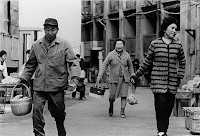
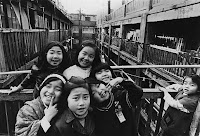
In that vein- here are a few photographs that Saiga Yuji took on
Gunkanjima when the island was alive and vital.
So we can remember that the basis of abandonment is not always fear.


Sunday, June 24, 2007

perdido street station and gunkanjima

Seven years ago, in Stockholm, I went to an art gallery.
A video was playing- a silent black and white documentary piece about an
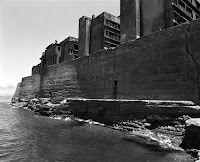
abandoned man- made city off the coast of Japan. The beauty in the abandonment
and decay was palpable. I've been trying to find out more about the city ever since- but had no name, no information at all.Yesterday, dawdling through websites and google earth, with no particular place to go, I typed in "abandoned city" into the search box.
And my city of decay rises up.
The site belongs to the photographer Saiga Yuji.
He is really the first to document this extraordinary place and its transformation.
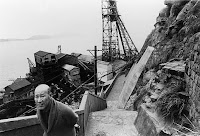
Gunkanjima was an island created for industry (coal) as well as housing its workers and thier families. There were temples and schools. Children rode their bicycles in industrial
back streets and played with dolls on the stairs of the workers housing. And then in 1973, it was closed down. Saiga Yugi was there when it happened, and he stayed until it was over.
Since then he has spent countless hours on the island. At night it is very strange.
Here are a few of his remarkable photographs.
Remember- this city was vital and living and real. People lived and quarreled and suffered and read books and stole things and dreamed and cooked and prayed and made love.


China Mieville is one of my favorite authors.

King Rat (1998)
Perdido Street Station (2000)
The Scar (2002)
The Tain (novella, 2002)
Iron Council (2004)
Un Lun Dun (February 2007)
The island of Gunkanjima exists quite comfortably (or uncomfortably) in Mieveille's world.

Thursday, June 21, 2007

resentment is drinking a cup of poison and hoping your enemy will die

Sue Lloyd


In her recent series photographer Sue Lloyd has captured the eerie sense
of being in danger, with no one around aware of your situation.
_______________________
I am angry tonight.

But if you are angry, you are feeling something.

Anger is deceptive.

There's a highway that it rides, through the amygdala, that primitive machine in your brain.

Somewhere else in the brain, that is supposed to be tamed, taken in, analyzed, understood.
Supposed to.

Not many of us can get past
the initial surge-
the corporeal bonds-
the steel trap door-
WHY are we angry.

Are we lonely?

Abandoned?

Singled out?

Left out?

"Anger is repressed creativity."

I appreciate that perspective.

It works pretty well for me.