Friday, July 16, 2010

nature loads the GUN - nurture pulls the TRIGGER


How can it be that a person born and bred from generations of alcoholics, arrives in this life as a tiny baby with the appropriate genetic code clutched in its fist, and moves through a lifespan never showing signs of addiction?

Biology has a strong hand.

Society has a strong hand too.


So it's no longer Nature vs. Nurture.

There's no arguement.

It's a handshake- with two sometime compatriots loading and firing a gun on a battlefield of evolution.

"It's good to see you", or perhaps, "I told you to stay away from me- now give me the gun"

Turns out there is a folding point, a weak spot in the fabric.
A trauma or event or series of events - often in early adolescence -
trigger the addict marker in the DNA....


and the rest uncoils.

Thursday, July 17, 2008

the "I", the "We"

There is no Starling "I".
The beauty of the watery sweep and inky line exists because of mindlessness.
To let ones self relax into the drift.
Which bird moves slightly to the left or leans into the wind to move the million towards that wild design?
The psychologists say that in mobs or riots, the crowds that run amok are steered by people deep inside the group.
The ones who cannot see.

So to those that are invested in the "flocking" theories for corporate workplace structures- be careful.

Individualistic vs. Collectivism.
The fraternal twins of different cultures.

One culture says- the good of the few.
The other- the good of the many.
The revolution of evolution.

But the Starling mind is not Collectivistic.
(Although the corporate encampments would like you to think it so. )
No creativity, no rebellion, no identity.
The Starling does not question.
Surrender.
Accept.
We are the We.

Monday, July 14, 2008

spiral, magnet, tree: THE CRAVING

The surge and the urge.
Addiction.
The MRI- the miracle machine that peeps inside the mind, and shows the addict brain pulse with pleasure just seeing a picture of a frosty beer, a crack pipe, the oxycontin tablet.

While the normal mind shows a stimulating sign when looking at a baby, a humming bird, a family photo.
http://www.magnetism.com/magblogarchives/2006/03/magnetism_shapes_dna_in_space.html
And DNA too!
The twists of genetic material that scribe the genes of a schizophrenic, a homosexual, and an alcoholic.
The mouth goes moist simply driving past the billboard where the woman in black velvet sips the drink or hold the bottle.

http://www.arborsmith.com/treecircus.html
And the tree!

The family tree- with little christmas lights for every relative afflicted with addiction or bi-polar or.....suicide at last.

Put on those boots.
Lace them tight and strive to be the one that lives to old age, and dies in ones bed sober.
You are not alone.
You will make it.

Sunday, July 6, 2008

the beauty of the Mark, the intention or ambivalence of the Maker

Robert Smithson 1970 diary page

william anatasi subway drawings

http://www.subwayseismo.com/about/

Often ( and for me as an artist this is not always a good thing) on the way to creating a new piece I will see a scrape on a wall, an inadverdent mark on a piece of tin or plastic, or the claw scrape of a wild animal on a tree and say to myself-


forget it! forget art!


you will never make a mark as provocative or beautiful.

parking lot markings
http://gscottage.blogspot.com/2007/08/pavement-markings-for-band-practice.html


artist Cy Twombly

http://www.menil.org/twombly.html


physicist Clint Sprott

http://sprott.physics.wisc.edu/

Tuesday, April 1, 2008

the sudden light, the shock, the rising

Mr. Colin Evans levitates in the late 1930's in an English church.
Spectacular photographs- look at the faces and gestures of the people in the audience.

These photographs are often identified as infrared, but that was not a process available during this time.
The photo uses a flash, in darkeness.
The people are shocked by the light- the incident they have been waiting for-the physicality of suprise.

Where are you going? And who are your guides?

This is one of the most beautiful and provocative photographs I know.
Taken in France in perhaps the 1930's, a psychic is blindfolded and led to a crime scene.
The image is like a dream- the three portly men in suits, two holding hands, the leader and the one led, into a landscape of the dark and dreadful.


Ted Serios' thought-o-photographs

Ted Serios was a regular guy, an alcoholic, a doorman at a local Chicago hotel.
He claimed to be able to create photographs on Polaroid film using his thoughts.

His claims were heard and then supported by psychiatrist Jule Eisenbud.

There were hundreds of strange gatherings that lasted all night.
Eisenbud would ply Ted Serios with liquor.
Sometimes physical acts of violence to property would ensue.
People invited to watch the process would find themselves harrangued.

But inevitably, several photgraphs would come out of the nights process, evidently made by Serios' thoughts, his grimaces towards the camera, and his gestures towards the lense with a small tube he called his Gizmo.
The Gizmo was shown to all as an empty metal tube.


These events came on the distant heels of a turn-of-the-century phenomenon known as the Spiritualist movement:
Ghosts, visits from the dead, automatic writing, ectoplasmic photography, knocking and tapping messages from Beyond.

The gap in those 40 or so years was capped by Ted Serios' thought photography.
Although much of the evidence that came out of the Spiritualist movement was proven to be fabrications, and there were many of the same claims toward Mr. Serios' work-
there has never been a succesful disprovement of the claims and the result of his work.
What is the story here?


Tuesday, November 13, 2007

eyrie


Sometimes its not the voyage that is perilous but the home port.

We build on unstable ground, take into our hearts unstable people, grow up in homes that have no foundation.

Occasionally our tenous homes are tolerated by those surrounding us.

Really, one can live in remarkable difficulty and get used to it: the man I see sleeping under an overpass in the middle of a ten lane highway.

My grandmother used to say, "if you are tired enough, you can sleep hanging on a nail"


There is more to say


Tuesday, November 6, 2007

amanita amanita amanita

Amanita Muscaria
Poisonous


I have been taking photographs of mushrooms. I am lucky to live in a place that is damp, wet, organic.
This year I have collected photographs of over 30 different species. I have followed the fruiting and life cycle of a patch of amanita muscarias. First they push up through dirt looking almost obscene- thick white bulb thrusting up to breaking the surface. This is the mushroom with its "universal veil". The bulb begins to change color and open its cap shortly afterwards, shedding the spores that were tightly kept inside. The cap opens and lifts- becoming an umbrella shape. The small white spots are what is left of the veil attachments. This amanita- in the photograph- was uprooted early, and lay on the ground exactly as I found it.

The mushroom glossary of J. Lindgren reads like a poem. Imagine someone reading aloud these
sensous and beautiful words.

Amanita muscaria- mysterious, veiled, beautiful, poisonous, potent....

GLOSSARY
abruptly bulbous - top of bulb flattened, sides and bottom rounded
adnate - gills which are broadly attached to the stipe
adnexed - gills narrowly attached to the stipe
amyloid - spores which stain bluish in Melzer’s reagent or iodine
annulus - a ring of tissue around the stipe
appendiculate - margin of cap fringed or adorned with fragments of the veil
areolae, areolate - spaces marked out on the surface, separated by cracks
attenuate - gradually narrowed
clavate - base thickened like a club
convex - regularly rounded, domed
disc - center of the cap


ellipsoid - spores with rounded ends and slightly curved sides
evanescent - slightly developed and soon disappearing
farinaceous - mealy to powdery particles on the cap or stipe; may also refer to the odor of fresh meal
fimbriate - gill edges finely fringed by cells
floccose - loose cottony or soft tufts of tissue
free - gills that are not attached to the stipe
fusiform - spindle shaped, tapering in both directions from an enlarged part
gills - the knife-blade-like structures on the underside of the cap
globose - spherical, like a globe
habit - the general, external, and characteristic appearance, or manner of growth


habitat - the natural place of growth
lamellulae - the short gills that do not span the whole distance from margin to stipe
limbate volva - membranous, attached closely around the bulb and with an open, free margin
marginate bulb - with circular ridge around top edge of bulb; in age it may flatten to look like wide shoulders on a rounded bulb
Melzer’s reagent - an iodine solution used to test for an amyloid reaction of the spore wall
membranous - like a membrane or skinlike
obtusely conic - rounded or blunt cone-shaped
plane - having a flat surface
pruinose - finely powdered


saccate volva - one shaped like a sack, cup or sheath
spores - the reproductive units of a fungus
stipe - the correct term for the "stem" of a mushroom
striate, striations - radiating grooves or lines on cap margin
subglobose - almost spherical
subumbonate - center of cap slightly or broadly raised truncate - appearing chopped off or abruptly ending
umbo, umbonate - having a raised knob or mound at center of cap
universal veil - the enveloping veil that covers an immature amanita and which breaks to form a volva at the base, and often leaving remnants on the cap
volva - the remains of the universal veil; usually refers to the structure found at the base of the stipe

Sunday, October 7, 2007

wax and lead, straw and pitch


"The transformation of waste"


http://www.pattismith.net/

When we walk in the dark land, where nails and blood and he hard screams of others scrape along our minds, we are in the Nigredo.
Alchemists said you needed pig iron and scrap in order to make gold.
Pig iron and scrap was what they called the Nigredo.
Jung said we needed to wade through the wastelands of our dreams in order to step up into the transformation.

The transformation of self.

As Patti Smith says- "the transformation of waste".


Anselm Kiefer paints in wax and lead, straw and pitch. His pieces are enormous- they span museum walls.


His lead books are gigantic. Some you may don white gloves and look into- but the pages quickly turn them black.
What is in these books?
The words of our death or of our transforming?

http://www.artchive.com

Monday, October 1, 2007

peering in with my giant eye


http://www.garde-rail.com/artists/jtaylor.html

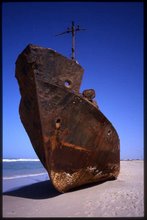
If there ever was a portal to New Crobuzon, John Taylor's vessels will take you through.
Each ship carefully made of pieces of scrap metal, wires, weathered bits of wood.
These are the artworks I'd fill my place with, if I could.

If for nothing else than to lie on the floor with, peering into the
windows with my big eye, imagining the voyage.
Reclusive, or perhaps simply quiet and without interest of public scrutiny,
John Taylor's works are sold out of Garde Rail Gallery.

New Crobuzon and the pirate vessels in The Scar, are in books written by China Mieville.


Sunday, September 23, 2007

the icon and its maker


In the 1970's, a piece of land art was constructed that spiraled off the Great Salt Lake.

The image and the memory, even if second hand, is pretty indelibly marked on several different groups and generations.

Understand, artist Robert Smithson has made no noises about claiming, in fact he is rather quiet.

So the questions here are rhetorical and meant to stretch to other iconographic works as well.

Is the artist responsible now for the archetypal quality, the coil of dense projection that has happened to this work?

Did he simply create the work and the interaction with the environment- and now should not accept the mastery or ownership-

I DID IT I DID IT I DID IT


Let go let go Let go

rascals


simonbellphotography.com

There are rascals in the world, and some of them are blue. Blue, with articulated eyebrows and feather capes.

When they first arrived, I had a misguided thought that I could train them to come to a command or clap.

I would match a clap with food.

But I was very very eager, and would find myself jumping up from my work when I heard them in the trees, stick my head out the window, and clap.

It wasn't long before I realized that they had trained me.

Trained me to pop out of the window at the sounds they made, sitting in the woods.

They can't clap, they have wings.

It doesn't matter, the rascals had won.

Tuesday, July 3, 2007

curiosity

The night sky .
(Click to enlarge.)

Ole Wurm's Kunsthammer

Turns out that wedged into the list of motivations and drives for a human being's old brain survival mechanisms-

(sex, hunger, thirst..)

is Curiousity.

Just the sheer tug of wanting to know what's outside the cave entrance- what is that little shiny thing winking and blinking, what is that strangely shaped object, what is that insect?

Curiosity helps our little human race progress- but certainly at a cost.

The idea of a room, or a case, or a box or even an entire museum dedicated to storing, squirreling, and collecting oddities is very appealing to me.

They could be actual objects, or perhaps concepts or dreams or half finished thoughts?

If you each out side the cave, you could retrieve something incredibly vital.

Or you could get eaten.

That's pretty much the deal.

www.strangescience.net/biopics/oleworm.jpg

http://home.no.net/ekerilar/computus_runicus.htm

http://en.wikipedia.org/wiki/Cabinet_of_curiosities

"In 1587 Gabriel Kaltemarckt advised Christian I of Saxony that three types of item were indispensable in forming a "Kunstkammer" or art collection: firstly sculptures and paintings; secondly "curious items from home or abroad"; and thirdly "antlers, horns, claws, feathers and other things belonging to strange and curious animals" "
(www. en.wikipedia.org/wiki/Kunstkamera)

The problem is- we're severing any opportunities for our children to engage in curiousity.

Everything is named, packaged, pronounced.

Anything that isn't, is declared to be of no value.

There's an astrophysicist named Woody Sullivan, who declares we are sending up so much ambient light from our cities and airports and factories, that we can no longer see the stars our parents did.

Light pollution.

"Analogies of loss of wonder
The dismantling of Cabinets of Curiosities or their assimilation into curated museums was a result of the rise of scientific/logical thinking as the accepted way of describing the world. The sense of a loss of wonder as 'scientific' thinking became the dominant way of looking at the world is expressed in Keats' lines on Newton 'unweaving the rainbow'. This loss of wonder seems to be analogous with the sense of loss experienced by children as the use of rational thought and language displaces their intuitive relationship with the world, as in Wordsworth's child for whom 'there hath passed a glory away from the World'. "
(http://www.curiosity.org.uk/whatisa.htm)


synched up

Magdalena Abakanowicz


I have two friends who confide in me about synchronism. Certain times in their lives when a found object, a card, a key might fall in their path, sometimes unlocking a series of events- sometimes but not always good. There's a high about it- a shallow breathing:


"is this it?"

"have I hit the jackpot?"

"will the angels show up in the next five minutes?"


Some people pick up the two of spades in the gutter and then disappear for several years.


Some people read the note written on a napkin left on a table, and then meet the one they love.


"Remember the cafe? And the note on the napkin? We looked at each other and knew..."


"Remember the card? How you abandoned me ?

It was as if you had been plucked from my heart.."